
Field Notes: Bahá’í Studies 2026 Mid-Year Wrap-Up


The Bahá’í Studies ‘Field Notes’ series is a new series dedicated to surfacing emerging research, publications, presentations, and other notable developments in the field of Bahá’í Studies, whether from formal academic or scholarly sources, or drawing on less formal but no less important efforts in the field. The scope focuses on notable fruits of the intellectual life of the Bahá’í community, emphasizing scholarship in the field of Bábi and Bahá’í Studies, but may sometimes draw on antecedents to the field, including new developments in studies on Shaykhism and Islam.
At present, there are too few active ‘digests’ of activity in the field, and yet new contributions to the field are regularly being made. The goal of this series is to connect interested readers with a broader view on the intellectual output of Bahá’í scholarship. This venue is envisioned as a small contribution to a regular periodical focus on emerging research, to include books, articles, podcasts & video presentations, events, and occasional reflections on the field.

Table of Contents
Select New Publications from 2026
New Volume of the Journal of Bahá’í Studies
Bahá’í Studies Review: New Publications and Past Volumes Now Digitized
Notable Videos & Lectures this Year
A Turning Point in Textual Studies of the Bahá’í Writings: Phelp’s Partial Inventory Updated
Select New Publications from 2026
Bahá’í Sacred Writings, Bahá’í World Centre
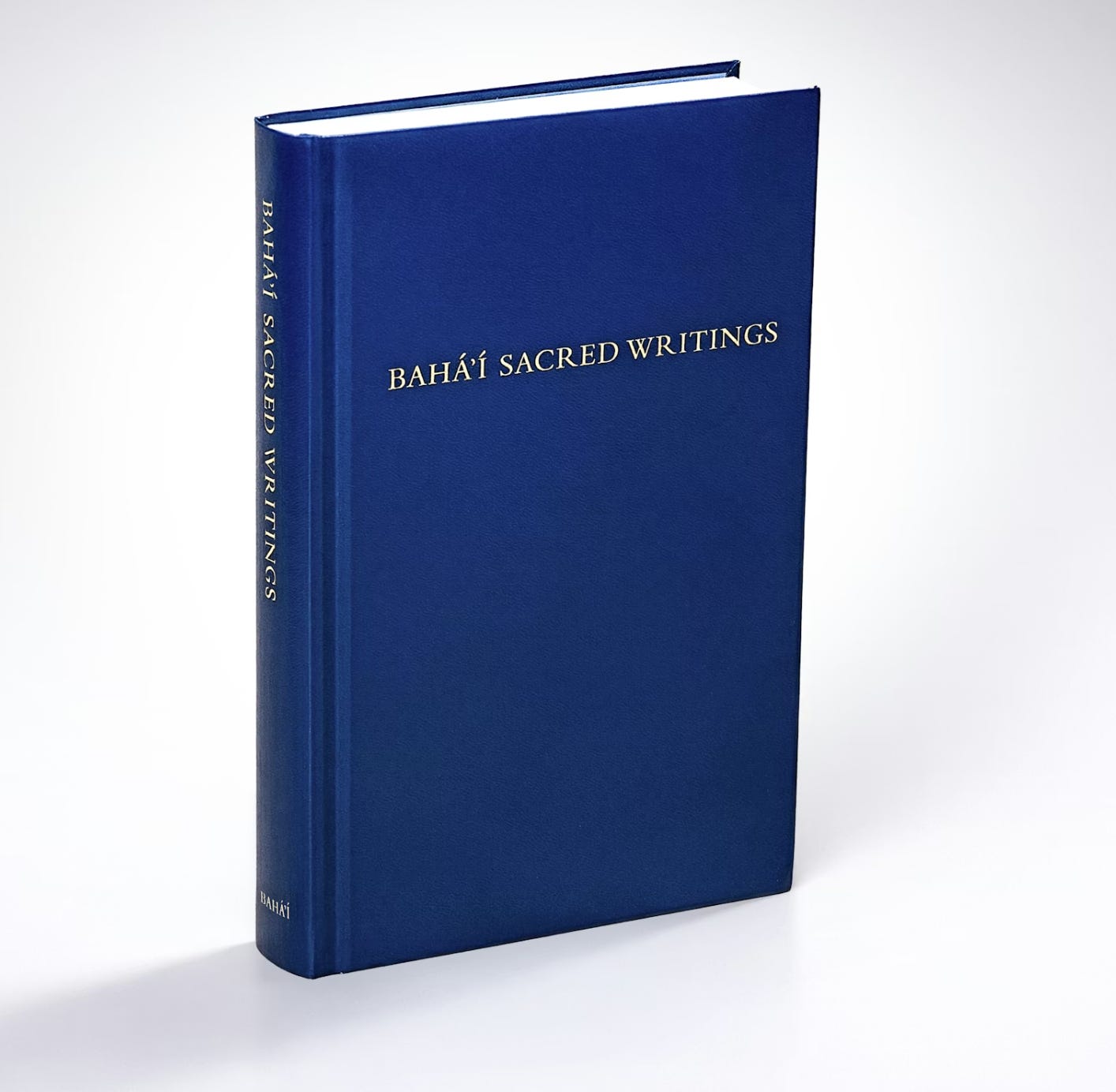
This newly published book gathers together in a single volume a comprehensive collection of selections representing the range of the Bahá’í teachings. Designed to serve as a resource that will support and reinforce the process of Bahá’í community development currently under way in neighborhoods, clusters, and villages worldwide, this collection intends to increase access to essential passages from across the Bahá’í Writings.
Given the vastness of the Bahá’í Sacred texts, in the past, single volume collections played a pivotal role in exposing readers to a wide-enough cross-section to begin building a comprehensive view on Bahá’í Teachings. These have since become out of print or have been superseded with new translations, and hence are out of date. Having a single volume collection is also critically important given the comprehensiveness and size of the Bahá’í Writings compared to other world religions. Having a single volume to recommend makes the Writings more accessible to those conditioned to expect something like a ‘bible’ for each religion.
The selections for this volume are also oriented around making available in a single volume a wide range of passages, especially for those whose initial encounter with the Bahá’í Faith has been through participation in Bahá’í community-building activities. It also includes a number of newly translated excerpts published in English for the first time. You can purchase a physical copy here, and a digital copy is available free at Bahá’í Reference Library.
Divinity and Manifestation by ‘Ali-Murad Davudi, translators Naeem Nabile-Akbar & Joshua D. T. Hall, George Ronald
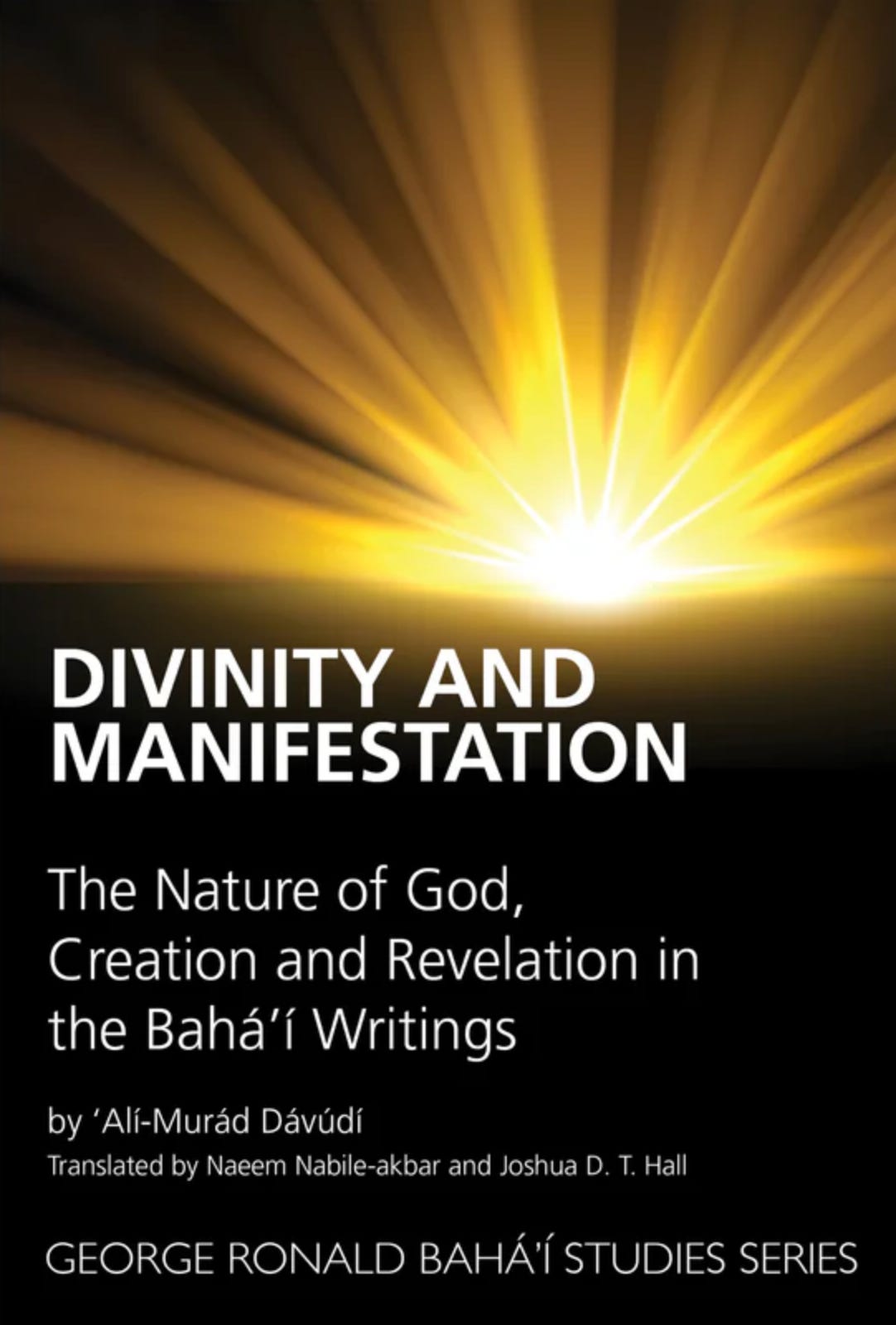
Dr ‘Alí-Murád Dávúdí was one of the preeminent Bahá’í scholars of the 20th century, a widely recognized Professor of philosophy at the University of Tehran, a member of the National Spiritual Assembly of the Bahá’ís of Iran, and a martyr of the Faith during the Islamic Revolution of 1979. Dávúdí’s scholarship has been an cornerstone of Iranian Bahá’í intellectual engagement with the Faith, but English readers have had fewer resources to engage his works until recently.
Divinity and Manifestation is a concise systematic treatise on Bahá’í theology, metaphysics and ontology. It is a translation of essays by Dr. Dávúdí on Bahá’í teachings on the nature of reality, the existence and essence of God and the relationship between Him and His creation as mediated through His Manifestations.
Another work of Dávúdí’s was published last year by the Association for Baha’i Studies North America, Revelation, Reality, and Reason: ‘Alí-Murád Dávúdí’s Philosophical Discourses on the Foundations of Bahá’í Belief and is also worth acquiring. With these two volumes English readership in the Faith are benefitted greatly.
“The Qur’án in Bahá’í Writings” by Todd Lawson, Necati Alkan in Qurʾānic Hermeneutics by Non-Muslims”, Volume 6 of the Handbook of Qurʾānic Hermeneutics
Engagement with the Qurʾān is a perennial duty for study of the Bahá’í Writings. In this chapter, venerable scholars Todd Lawson and Necati Alkan provide an overview the role of the Qurʾān in Bahá’í religiosity, situating the Bahá’í’s as a non-Muslim community of readers of this sacred text, and exploring the Bahá’í approach and contribution to Qurʾānic hermeneutics. The volume this chapter is part of is part of a multi-volume series on hermeneutical approaches to the Qurʾān, not only by pre-eminent Muslim scholars but by other communities who engage with the Qur’an in their own respects. The chapter is available here,
New Volume of the Journal of Bahá’í Studies
A new volume of the Journal of Bahá’í Studies was released in May featuring a strong selection of articles oriented around the thematic of education, particularly what ultimately constitutes a proper education, particularly one that enables true human flourishing. The volume includes three articles with diverse framings that touch on this underlying theme:
Baha’i-inspired Educational Endeavors and Social Justice by Ilya Zrudlo & Ashraf Rushdy
Expanding on a Bahá’í-Inspired Pedagogy of Social Transformation by Justin Scoggin & Yma Marañón Davis
Interdisciplinarity, Connectivity and Capability: An Exploration in the Context of Social Change by Felicity Rawlings-Sanaei
In addition to the three main articles, the volume includes two poems and three reviews, of greatest interest being the two reviews on last years groundbreaking work “Exploring the Kitáb-i-Aqdas: The Laws and Teachings of the Bahá’í Faith” by Omid Ghaemmaghami and Shahin Vafai. One review is by Vargha Bolodo-Taefi, the other one by Roshan Danesh, both well-equipped to shed light on the book and the underlying material.
Bahá’í Studies Review: New Publications and Past Volumes Now Digitized
The Association for Bahá’í Studies UK has a rich history of publications through its Journal, “Bahá’í Studies Review”, focused on offering Baháʼí perspectives on contemporary issues such as peace, human rights, ethics, governance, development, as well as in-depth study of the Baháʼí teachings, its laws and principles, and the history of the Baháʼí Faith, its central figures and the development of the Baháʼí community.
The journal was relaunched last year after a multi-year pause and we are already benefitting immensely from the effort. The journal is now making new publications available online first, and new scholarship is added throughout the year. Finally, a whole host of previously unavailable print material is now available online.
Recent BSR Publications
The most recent batch of publications span from late last year, up to the present, with a recent addition in June 2026. The flexibility and volume of publications afforded by the Bahá’í Studies Review as returning venue is notable: from research notes, to formal scholarly papers, provisional translations, and more. This promises to be a great space to watch for emerging scholarship in the coming years.
Research Notes
Bertrand Russell’s links with the Bábí-Bahá’í religions: a research note
Seena Fazel and Payvand Agahi | March 2026
Papers
A Thought Experiment from ‘Abdu’l-Bahá: Implications for Hume’s Problem of Induction
Philip J. Smith, Homa S. Smith, and Daniel C. Salter | June 2026
Science and Religion: how can the Bahá’í Faith contribute to the existing discourse?
Warren Houghton | December 2025
Some of the Earliest References to Bahá’u’lláh in the West
Jan Teofil Jasion | December 2025
Provisional Translations
Bahá’u’lláh’s Warning to Mírzá Muhammad-’Ali in a Tablet to Siyyid Mihdíy-i-Dahájí: Provisional Translation and Commentary
Aaron J.R. Ferguson | December 2025 [my own publication, detailed here]
Bahá’u’lláh’s Tablet on the Simple Reality (Lawh-i-Basíṭu’l-Haqíqih): A Fresh Provisional Translation and Exegetical Introduction
Joshua D.T. Hall | December 2025
Past Volumes
A whole host of older volumes are now digitized and are now available online. It is an excellent treasure trove of articles.
Notable Videos & Lectures
“Logos and Primal Will as Unitive Principle”, a 7-part lecture series by Steven Phelps
“Logos and Primal Will as Unitive Principle” is a 7-part lecture series by the cosmologist, translator, and Baha’i scholar Steven Phelps. The lectures are recordings from a weekend-long seminar on the central role of the Baha’i concept of the "Primal Will" in addressing fundamental questions of religion, God, and purpose. The lecture traces this concept, prominent in Baha'i Writings, to its ancient roots across various traditions where it appears under different names. Several digital resources are provided, including QR codes for reading materials, a thematic compilation of Baha'i writings, the Steven’s NotebookLLM instance that allows visitors to conversationally explore a vast, computer-translated collection of Baha'i sacred texts. The capabilities and caveats of using AI for translating sacred scriptures are also discussed.
ORIGINS & TEACHINGS OF SHAYKHISM: A Conversation with Dr. Youli Ioannesyan
A conversation between two Baha’i scholars, Iranian studies scholar and Doctor of Philology, Youli Ioannesyan, and Dr. Mikhail Sergeev. The conversation discusses two of Dr. Ioannesyan’s recently published books devoted to the study of the history of Shaykhism, the unique mystical movement within Shi’i Islam from which Bábism emerged, which later gave rise to the Bahá’í Faith. Shaykhism represents a vast iceberg of thematic threads woven into the Babi and Baha’i Writings. One of these works is 2023’s “The Shaykhi religious school : historical subjects, teachings” is an academic study on Shaykhism that uses primary sources to systematically present the teachings of this mystical school of Shi‘ism. I haven’t yet acquired it, but it is high on my wish-list. It was recently reviewed by Christopher Buck, published in Nova Religio.
Mystical Knowledge in the Writings of the Báb - A Conversation with Todd Lawson and Steven Phelps
Lecture in Honor of the 150th Anniversary of ‘Abdu’l-Baha’s Secret of Divine Civilization, Necati Alkan
The Path of Beauty: Journeying through the Seventh Valley to Transformation by Rhett Diesner
Abdu’l-Bahá on the Spiritual Heritage of Indigenous Peoples by Dr. Christopher Buck & Mr. Michael Orona
A Turning Point in Textual Studies of the Bahá’í Writings: Phelp’s Partial Inventory Updated
It is hard to overstate the monumental shift the field Bahá’í Studies has experienced in the last few years due to the indispensible Partial Inventory project of Steven Phelps.
This project, available publicly for around 6 years now, is an unofficial catalog of over 680 works of the Bab, 11,900 works of Bahá’u’lláh, and 12,800 works of ‘Abdu’l-Bahá. Collectively, it brings together a catalogue representing north of 9 million words in total, approaching 60% of all known works of Bahá’í scripture. What it accomplishes in a single (nearly 1,400 page long pdf catalogue) is a way to systematically refer to and access all these known works via bibliographic codes, work-by-work metadata, and thus begin to get a grasp on the massive “ocean” of the sacred scripture of the Faith. Without this effort most of these works would remain painfully hard or practically impossible to access.
Starting from last year all these works were made accessible via a NotebookLLM instance that included AI-produced provisional translations of all works that had not been available outside the original language. You can query the corpus of texts using a chatbot which is fixed to provide responses based on ‘retrieval augmentation’, strictly drawing from direct sources in the corpus [in this case, the approx. 9 million-word corpus of official and provisional translations].
The latest update from Steven, presented in May, is that the full corpus of provisional translations from this project are now available in a 194-volume pdf series featuring side-by-side arrangements of original languages and translations for every single text in the Partial Inventory.
To say this is revolutionary for Baha’i scholarship is a criminal understatement. It represents a massive shift in ability of scholars and those engaged in deep textual study of the Writings to plunge into mostly uncharted depths of the Revelation, spanning across the entire central corpus of Baha’i scripture, on the widest possible range of topics [ask anything you desire and you will find a wealth of resources in the Writings to explore that question! Side-by-side arrangements now make it easy for those with fluency in English and the original languages to critically assess the machine translations for accuracy, a notable flaw of the prior update, which was often limited in access to the more obscure texts in the original language.
In addition to these newly available volumes, there are now two instances of the NotebookLLM “Partial Inventory Explorer”.
One is the original instance featuring English machine translations, now arranged chronologically from the beginning of the Faith [1844 and before] to the end of ‘Abdu’l-Baha’s ministry [1921].
One is a new NotebookLLM instance that makes available all the texts in the original languages [Persian & Arabic], meaning that you can submit queries and the responses will be retrieved from the original text, not translations. This is incredibly useful for researchers doing work in multiple languages (such as yours truly).
The following video summarizes Steven Phelp’s latest update on his multi-year project to systematically arrange, catalogue, and now provisionally translate [driven by AI] all publicly available writings of the Central Figures of the Baha’i Faith.
Further update to the “Partial Inventory”
The presentation was recorded during a session of the academic conference on Shaykhi, Babi and Baha’i studies at Oxford University on May 29, 2026, which I had the benefit of attending [reflections on the conference forthcoming].
Download volumes 1-194 via DropBox.
The English NotebookLM instance containing the translations (Gmail account required).
The Persian/Arabic NotebookLM instance containing the original texts (Gmail account required).
New Frontiers
We are only at the beginning of new frontiers in textual study of the Baha’i Writings. These tools come with important caveats, including the fact that, while machine translations have advanced in quality to an astounding degree, they are still frequently and impactfully very wrong on many occasions. The provisional nature of this effort must be underscored, and anyone engaging with these translations must hedge what they learn with the knowledge it may be overturned by a much more careful analysis, careful translation, or by realizing that an error was made somewhere in the pipeline to produce these translations [such as a transcription error from the manuscript, a fabrication in the AI’s translation, a fabrication in the retrieval of the source, etc.]. As such, this tool is best suited for those with strong training in research & critical thinking, and better still, at least some command of the original languages. In my almost daily use of these tools, I regularly encounter mistakes and errors, some insignificant, some more notable. So proceed with caution.
But even still, these tools will only continue to progress and improve from here. There are new vistas right around the corner for rigorous exploration of the massive corpus of Baha’i scripture and Phelp’s current tools already represent a paradigm shift for Baha’i Studies research. Additional tools will no doubt emerge in the coming months and years as AI increases in capacity.

This is a very interesting and useful post!