‘Librarium’ is a series to catalogue books in my collection and expose the invaluable written works that have brought joy, illumination, and otherwise enriched the ‘vita contemplativa’. They will range from well-known to the obscure, from fiction to historical, anthropological, philosophical, religious, scientific, and miscellaneous works. Each post will showcase approximately one ‘shelf’, share the titles and authors, offer a short description, and my impressions of the value I’ve found in it.
By the very fact I have these books I consider them all ‘worth having’ and recommendable; so I will also ‘rank’ each work on two scales. First, on ease of access: ‘accessible’ - ‘intermediate’ - ‘advanced’ - ‘traveller’s beware’. Second on a non-ordinal scale of ‘aspirational’ [e.g. I haven’t read or finished it yet], ‘an enjoyable read’ - ‘specialist interest’ - ‘essential knowledge [for it’s field/topic]’ - ‘life-changing’ - ‘world-changing’.
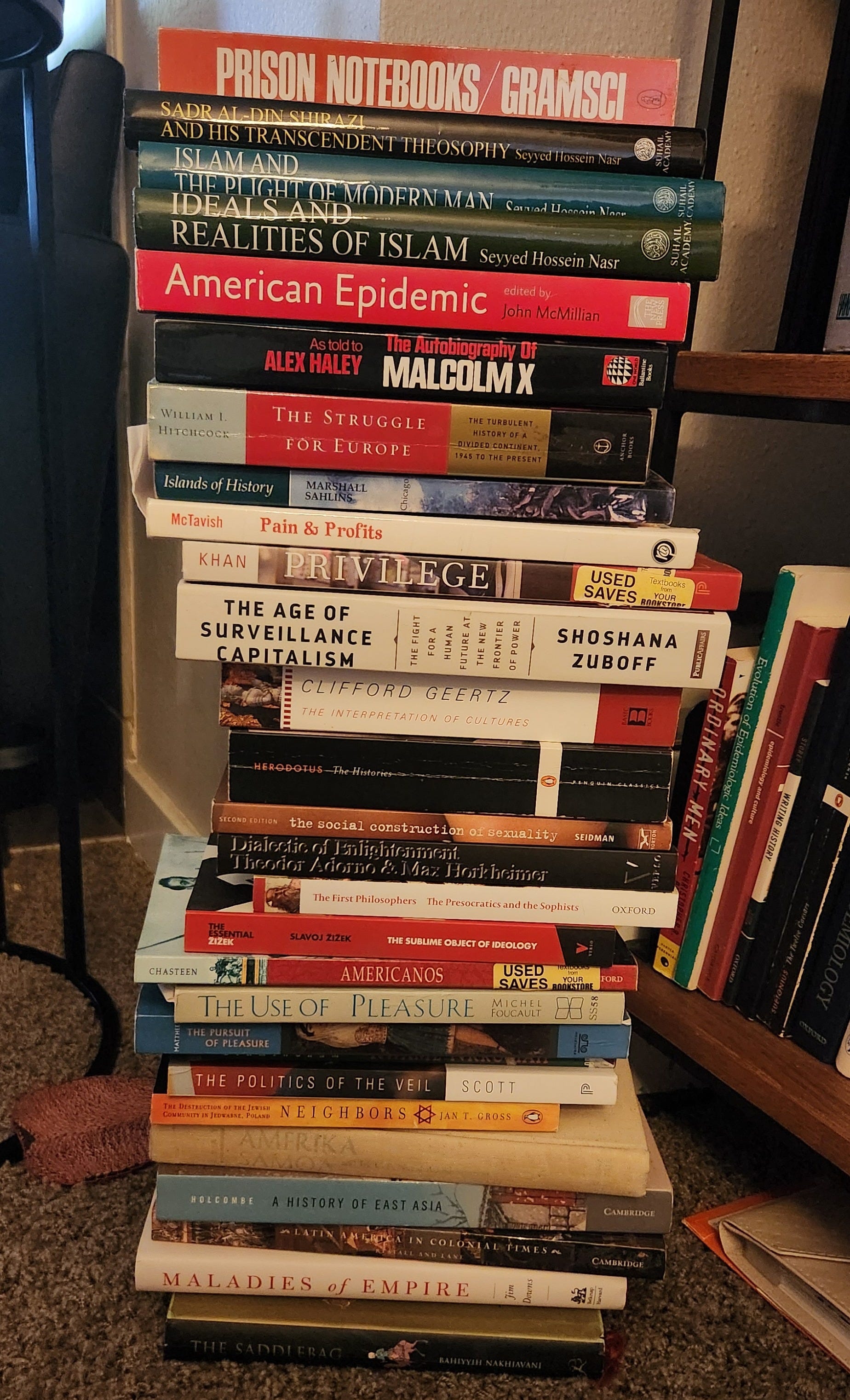
Stack I
In this stack: Islam, Islamic Philosophy & Sufism • Post-Structuralism, Anthropology, Marxism & Cultural Theory • Critical Theory • Enlightenment & Modernity • History of Drugs, Substance Use • Racism & Racial Justice • Sociology of Sexuality • Greek Philosophy & History • WWII & Holocaust Studies • History of Medicine & Social Determinants of Health • Latin American History, East Asian History
From Left to Right
1. Selections from the Prison Notebooks of Antonio Gramsci - Antonio Gramsci
Intermediate-Advanced. Essential Knowledge.
Antonio Gramsci (b. 1891) was an Italian socialist activist, journalist, and organizer who posthumously became one of the most notable Marxist cultural theorists and political philosophers. His ‘Prison Notebooks’ were written during his political imprisonment by the Fascist authorities in the interwar years, an imprisonment that ultimately led to his early death (d. 1937). It explores a more ‘sociological’ and organic reimagining of orthodox Marxist theory & philosophy through rich contemplation of the nature of ideology, accounts of the operations of power and social control, and an emphasis on ‘praxis’ in the dynamics of revolutionary politics. He introduces his pivotal concept of ‘hegemony’, which has become enormously influential in cultural and political analysis broadly, beyond just the confines of Marxist thought.
2. Sadr al-Din Shirazi and His Transcendent Theosophy – Seyyed Hossein Nasr
Accessible. Enjoyable read.
A scholarly study and introduction of Mulla Sadra’s metaphysical system that unites philosophy, theology, and mysticism within Islamic thought. Seyyed Hossein Nasr is one of the most influential modern Islamic philosophers, a prolific thinker, whose notable corpus includes an extremely valuable translation of the Qu’ran (the Study Qur’an, perhaps the best scholarly English version, introduced here). SH Nasr’s works include a range of translations of classical texts in Islamic philosophy but also a wealth of innovative contributions of his own. In this work, Nasr provides an accessible scholarly introduction to the transcendentalist philosophy of Mulla Sadra, perhaps the most important Islamic philosopher of the past 4 centuries. This work is among the earliest studies of Mulla Sadra in English, igniting interest in the West about Sadrian philosophy. Highly recommended for anyone who wants an accessible introduction, especially if you’re not prepared to read the primary texts.
3. Islam and the Plight of Modern Man – Seyyed Hossein Nasr
Accessible. Enjoyable read.
Over the past centuries there has been an uneasy political, intellectual, and spiritual relationship between Islam and so-called ‘modernity’ (really, European ‘Enlightenment’ and its global political and epistemic hegemony). This has provoked a great number of diverse internal reflections and responses within the Islamic community on the influence of European modernity, anxieties the ‘clash of civilizations’, historical conflicts, and attempts to situate or re-envision Islamic civilization within a new era. In this work, Seyyed Hossein Nasr makes his own contribution to this tradition by critiquing the spiritual emptiness of modern secularism, recovering a uniquely Islamic anthropology, and calling for a revival of sacred knowledge rooted in the Islamic tradition.
4. Ideals and Realities of Islam – Seyyed Hossein Nasr
Accessible. Enjoyable read.
Another work by SH Nasr. Nasr, alongside such figures as Henry Corbin, was particularly influential in reinvigorating (or establishing in truth) the presence of Islamic thought within the Western academy. Nasr’s 1960s “Three Muslim Sages”, for instance, was for a time the main or only source of introduction for many to Ibn Sina, Suhrawardi, and Ibn ‘Arabi. It remains a worthwhile and accessible read even though superseded by other works since. “Ideals and Realities of Islam” is a collection of thematic essays that introduce the intellectual, spiritual, and ethical foundations of Islam, with a perennialist leaning, given Nasr’s role as a leading figure within the “Traditionalist School”. As one sees from actually studying his thought, some features of Nasr’s “perennialist view of Islam”, if we can call it that, are not so much ‘perennialist’ as they are integral to what Islam is, and further to this, what the Baha’i Faith is [more on this in future essays]. As a result, it will be deeply familiar and consonant in many ways for Baha’i readers. But it will also challenge those who’ve adopted certain diminutive or exclusivist views of Islam.
5. American Epidemic: Reporting from the Front Lines of the Opioid Crisis – edited by John McMillian
Accessible. Enjoyable.
A collection of journalistic accounts examining the human and systemic dimensions of America’s opioid epidemic, especially in some of its worst years throughout the 2000s and 2010s. Its articles touch on the drug war, addiction, first responders, the paramedics, the addicts, the toll on families, and impacts on the medical system as a whole.
6. The Autobiography of Malcolm X – as told to Alex Haley
Accessible. Life Changing.
The life story of Malcolm X, tracing his transformation from street hustler to his conversion into a revolutionary pastoral leader of American black Islam, and then to one of the most powerful voices for Black liberation, anti-racism, and human rights. I was introduced to this work in high school by my freshman year English teacher and I’ve never stopped thinking about it since. It’s one of the most valuable single books you can read to blow the lid off the conventional discussion of racism in America and awaken you to the realities of racial hatred, reflections on liberation. It is one of the most common books I’ve gifted/recommended, especially to youth. But really every person in America should read this book and reflect on it.
7. The Struggle for Europe – William I. Hitchcock
Intermediate. Specialist Interest.
A comprehensive history of how Europe rebuilt itself politically and economically after World War II amid Cold War tensions. First read during my undergraduate sophomore year, it is an immensely rigorous and well-written. History is essential to understanding the present, and all the more so should one have an understanding of the most immediate and major movements within the history of the past century. If you want an advanced perspective on contemporary developments, works like this are indispensable.
8. Islands of History – Marshall Sahlins
Intermediate. Specialist Interest.
A landmark anthropological work that examines the interplay between culture, history, and human agency, particularly in Polynesian societies. I read this work while developing my emphasis on Pacific history in undergraduate, an emphasis that eventually motivated my history thesis on American imperialism in the Samoan Islands. This work was an extremely influential theoretical foundation for me, and Marshall Sahlins is one of the most creative thinkers in historical anthropology in the past century.
9. Pain and Profits: The History of the Headache and Its Remedies in America - Jan R. McTavish
Intermediate. Specialist Interest.
A work in the history of medicine that focuses on professionalization of doctors and the consolidation of their authority, the rise of the pharmaceutical industry, and the emergence of mass production of drugs. These are explored through the lens of the headache and its varying medical treatments as a case study to explore the rise of modern drugs & medicine and the historical & sociological consequences of medicalization and pharmaceuticalization.
10. Privilege: The Making of an Adolescent Elite at St. Paul’s School – Shamus Rahman Khan
Accessible. Enjoyable read.
An ethnographic study revealing how elite education reproduces class privilege in modern America. Excellent reading for understanding the ‘sociology of elites’ and wealth inequality. One of the critical oversights in research that this book corrects is the emphasis on poverty and the conditions and causes thereof, absent of an account of and sociology of the wealthy, the nature of ‘elite reproduction’, the consolidation of the wealthy class, and the social, political, and economic capital they wield to maintain the status quo and reinforce social inequality. Shamus Khan’s work here is a superb testament of the power of ethnographic research to uncover rich qualitative perspectives on under-examined dimensions of social reality.
11. The Age of Surveillance Capitalism – Shoshana Zuboff
Accessible-Intermediate. Essential Knowledge.
This 2019 work is a major critique of how a new class of corporations exploit personal data to shape behavior and consolidate power in the digital age. In this work, Shoshana Zuboff provides one of the first major foundational perspectives on a new economic order rooted in the rise of the digital economy, the tech industry, and the consequent reshaping of the dynamics of capitalism via a new producer-consumer and market imperatives. This book builds on her prior 2015 article Big other: Surveillance Capitalism and the Prospects of an Information Civilization. Surveillance capitalism is “a new economic order capitalizing on the raw human experience” as its essential material. Combining scientific methods of extraction, ‘dark patterns’ of hidden commercial extraction, prediction, and a “global architecture of behavioral modification”; reliant on mathematics and a system-assemblage of hyper-connected technologies enmeshed in the fabric of social, collective life in such a way that enables it to harvest previously unobtainable dimensions of human life and convert it into knowledge-power. It is by nature extremely pervasive, and extremely persuasive.
“Just as industrial capitalism was driven to the continuous intensification of the means of production, so surveillance capitalists and their market players are now locked into the continuous intensification of the means of behavioral modification and the gathering might of instrumentarian power.”
Since its release its reflections have only become more relevant in the face of ongoing digitalization, the proliferation of consumer AI, and capital accumulation within the elite companies of the tech industry.
12. The Interpretation of Cultures – Clifford Geertz
Intermediate. Essential Knowledge.
A collection of essays that defines the interpretive approach to anthropology, emphasizing “thick description” and meaning in cultural practices. T
13. The Histories – Herodotus
Accessible. Essential Knowledge.
Alongside Thucydides, Herodotus’s ‘the Histories’ is among the earliest known works of Western history and historiography, chronicling the Greco-Persian Wars and diverse customs of the ancient world. It is often (fortunately and unfortunately) the only available source on certain topics. I love reading this book in bed before falling asleep, as the depictions it shares of the ancient world are absolutely fascinating and stimulating to the imagination.
14. The Social Construction of Sexuality – Steven Seidman
Accessible. Enjoyable read.
A great introductory work to the sociology of sexuality, that complicates simplistic and reductionist views of gender and sexuality as mere accidents of biology. This work explores the sociologic underpinnings of how sexual identities and norms are produced through social, historical, and political processes.
15. Dialectic of Enlightenment – Max Horkheimer & Theodor W. Adorno
Intermediate. World Changing.
A cornerstone of critical theory arguing that Enlightenment rationality, when turned instrumental, leads to domination and barbarism. Adorno & Horkheimer, reflecting on the supposed ‘promises’ of the Enlightenment project and their anthesis in the horrific consequences of WWII and the holocaust set out for themselves the task of “nothing less than the discovery of why mankind, instead of entering into a truly human condition, is sinking into a new kind of barbarism.” This pioneering work contemplates the very self-destruction of the Enlightenment, collapsing under the weight of its own internal contradictions. Their effort was intended to ameliorate these incoherences through vigorous critique of the foundations and intrinsic contradictions of modernity, in an attempt to free it from blind domination, through the emergence of new notions of Enlightenment and understandings of culture and ideology. Horkheimer would later introduce the foundations of ‘Critical Theory’, and both Horkheimer and Adorno laid the foundations for many of the most transformative intellectual projects of the late 20th century. This work still remains an essential read and is largely unanswered in the critiques it levies against the Enlightenment. Many of the self-contradictions they lay out are still coming to fruition today.
16. The First Philosophers: The Presocratics and the Sophists – translated by Robin Waterfield
Intermediate. Essential Knowledge.
Presents key fragments and ideas from the earliest Greek thinkers (Parmenides, Zeno, Anaxagoras, Heraclitus, Thales, Empedocles, etc.) who laid the groundwork for Greek philosophy and later Western thought. The Presocratics are often unfairly dismissed in favor of the certainly magnificent philosophical contributions of Socrates, Plato, and Aristotle. And while that trio certainly deserves the influence and preeminence, the so-called ‘Presocratics’ have extremely important and fascinating contributions of their own that deserve more attention and greater status than a mere footnote ‘prelude’ to Socrates. Most notably, in my view, are (1) Empedocles and his synthesis of elemental cosmology and concepts of the supraordinate principles of love-order and strife-chaos, as well as (2) Parmenides and his foundational work in ‘ontology’, the study of existence itself or ‘being qua being’.
17. The Sublime Object of Ideology* – Slavoj Žižek
Advanced. Essential Knowledge.
Slavoj Žižek is a provocative and original thinker and “The Sublime Object of Ideology” is widely regarded as his most exemplary work. He contemplates the movement of ideology in history and its role as a ‘sublime’ and structuring influence on human desire and belief. He does so through a tour-de-force reimagining of Marxist theory via a merger with Lacanian psychoanalysis, touching on Hegel and many other prominent dialectical and critical thinkers of the past two centuries. No summary of this work or Žižek himself can really do justice, he just needs to be experienced.
18. Americanos: Latin America’s Struggle for Independence – John Charles Chasteen
Accessible. Specialist Interest.
A vivid narrative history of the revolutions that ended colonial rule across Latin America in the early 19th century. Provides a broad overview of colonialism in the Americas that is essential for understanding the nature of imperialism and the enduring influence of these political structures on contemporary society.
19. The History of Sexuality, Vol. 2: The Use of Pleasure – Michel Foucault
Intermediate. Essential Knowledge.
The second volume of Foucault’s four-part “The History of Sexuality”, exploring how ancient Greek ethics shaped modern conceptions of self and desire. There are few works on the philosophy of sexuality that are as generative as this multipart series of Foucault.
Foucault is a polarizing figure, often loved, often vigorously hated. I find his thought enduring and fascinating, even as I regularly disagree with his underlying premises or some of his perspectives on society. Yet you should not believe anyone who charges him with the ‘crime’ of obscurantism. His work is challenging, and his style packed with creativity, truly novel ideas, and ones that are often persuasive. This has earned Foucault a status as one of the most cited social philosophers (but also earned him deserved and undeserved critique). Whatever your disagreements, there is a core substance to his thought worth considering, even if you eventually deny his points or disagree with his political project and its consequences.
20. The Pursuit of Pleasure: Drugs and Stimulants in Iranian History, 1500-1900 by Rudi Mathee
Intermediate. Specialist Interest.
Iranian historiography has had a preponderant focus on poetry, religion, & geopolitics, aspects of a purported immaterial romantic ‘essence’ of Iran. Matthee shifts away from these focuses, emphasizing otherwise undiscussed elements of Iranian history. The materiality of drugs and stimulants as commodities takes center stage as he traces the historical development of Iranian ideas of taste, pleasure, status, acceptability, and respectability in relation to these substances. In doing so he seeks to reveal significant aspects of Iranian society through the ‘prism’ of drugs and stimulants (in this case, opium, alcohol, coffee, & tobacco). He sees this approach as eliciting a ‘dialogue between their status as a part of material culture - as concrete, tangible consumables with a physical working - and the array of meanings Iranian’s have attached to them over a period of four hundred years...”.
This work is an outcome of the broader trend of ‘Commodity Histories’ a la the anthropologist Sidney Mintz and his seminal work “Sweetness and Power: The Place of Sugar in Modern History” [see a future post on another shelf]. Yet unlike some works in this historiographical trend, the foundation is rigorous, the implications powerful, and the light it sheds on underexamined aspects of Iranian history outside the dominating influence of art, aesthetics, religion (and most recently geopolitical conflicts) makes it an invaluable contribution to Iranian historiography.
21. The Politics of the Veil* – Joan Wallach Scott
Accessible. Enjoyable read.
Examines France’s ‘headscarf’ controversy as a lens into gender, secularism, and the politics of identity in modern democracies. These debates are still raging 20 years later and still fall into many of the pitfalls and traps that this book sought to identify and correct, hence it is still worth a read.
22. Neighbors: The Destruction of the Jewish Community in Jedwabne, Poland – Jan T. Gross
Accessible. Life-changing.
A haunting investigation into the 1941 massacre of Jews by their Polish neighbors, challenging national narratives of WWII innocence. There are few books that pierce your soul as thoroughly as this one does. Giving new and horrifying insights into human nature, particularly the transition from common neighborliness into bloodthirsty and rapacious genocide, this book will stir you to your core as you consider the truth that ‘if it happened there, it can happen anywhere’.
23. Amerika Samoa…
24. A History of East Asia: From the Origins of Civilization to the Twenty-First Century – Charles Holcombe
Accessible. Enjoyable read.
A valuable sweeping survey of East Asian history, emphasizing the interconnected cultural and political sphere of ‘East Asia’, via the histories of China, Korea, Japan, and beyond. If you want a single introductory work to cover gaps in your historical and cultural understanding of this major and important region of the world, this is a great place to turn to.
25. Latin America in Colonial Times – Matthew Restall & Kris Lane
Accessible. Specialist interest.
Another excellent and detailed history of Latin America under Spanish and Portuguese rule, highlighting indigenous resilience and colonial transformations.
26. Maladies of Empire: How Colonialism, Slavery, and War Transformed Medicine – Jim Downs
Accessible. Enjoyable read.
A valuable work that breaks new ground the interconnection of colonial and military enterprises in the age of imperialism and how these shaped the foundations of modern medicine and epidemiology.
27. The Saddlebag: A Fable for Doubters and Seekers – Bahiyyih Nakhjavani
Accessible. Enjoyable read.
A mystical novel set in the 19th century, weaving together intersecting lives touched by a mysterious saddlebag and contemplating spiritual transformation and transcendence in the midst of the accidents of life. It is inspired by a brief episode of a stolen saddlebag of sacred writings described in “The Dawn-Breakers” the pre-eminent narrative history of the origins of the Babi and Baha’i Faiths.